By David Papke

In the spring of 1872, Amos Ives Root of Medina Ohio planted 4,000 basswood saplings, hoping to reap in ten or fifteen years time an annual harvest of pure basswood honey. Mr. Root was a businessman and beekeeper who founded the A.I.Root Beekeeping Supply Company (1869) as well as the monthly periodical Gleanings in Bee Culture(1873). By 1877, many of the trees were “bearing fair loads of blossoms.”
The idea of planting nectar-producing plants for honey production is not new; however in practice, the results may not be as great as one might hope. In his writings, Root never mentions the planting again. It appears, however, that Mr. Root had an ulterior motive. At the time, the centrifugal honey extractor had just been invented and in the marketplace honey was typically sold ‘in-the-comb,’ often in 4” square section boxes made out of basswood. As an economic decision, the planting alone would never reap the financial reward intended until it was coupled with another economic benefit; in this case, a future supply of raw materials for the section boxes his company made and sold.
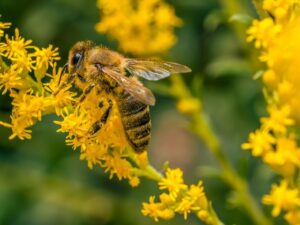
In lieu of planting forage for honeybees, enterprising beekeepers today seek out locations where there is an abundance of natural or agricultural forage - think of the vast fields of nectar-rich alfalfa, clover and rapeseed in the upper Great Plains or the Tupelo swamps of the Southeast. But for most beekeepers, our colonies depend upon of the natural vegetation within a roughly three-mile radius of our apiary. So, is there any substantial benefit in planting for honeybees? Any economic benefit of such a planting would be improbable; however, there are other kinds of benefits - when such plantings are coupled with an ecosystemic benefit, one which favors the preservation and stewardship of the environment as a common good, the benefits cannot be ignored.
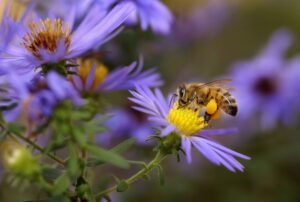
For beekeepers, wherever they live, planting blossoms for honeybees is an act of hope and gratitude. In doing so, one gains a deeper appreciation for all pollinators, along with a sense of how all living things are connected and interdependent, each one intrinsically adapted to its habitat. Each one of us can exert an influence on the habitat surrounding our apiaries - first, by observing the kinds of plants and trees which grow there naturally, identifying those which are most important to native insects and wildlife, then by increasing their numbers and working to enhance and expand the diversity of that landscape. Restoring habitats can help to revitalize entire ecosystems.
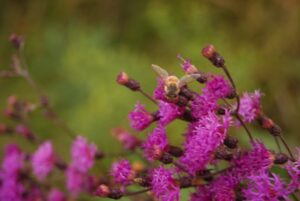
My home apiary is located in a wetland conservation district; land usage restrictions and zoning serve as a curb against over-development. This year I have been happily astounded not only by the sheer numbers of insects I’ve seen but also by several species I had not noticed before. In the past 28 years, we have eliminated or reduced the prevalence of many invasive plant species that aggressively compete with native plants. We have increased the number and variety of wetland species by transplanting or seeding areas to maximize the floral diversity, and we have welcomed bee-friendly native “weeds” like goldenrod, asters, ironweed, and bee balm. Large swaths of old lawn are now left to grow wild or are selectively planted, mowed once a year in late spring to protect nesting sites for insects. Trees planted, some now 25 years old, are scattered throughout the landscape: black locust, redbud, basswood, tulip poplar. Maryland beekeepers, Art and Barbara Gruver promoted the value of such plantings and taught many beekeepers to think of trees as “vertical blossoms;” a single basswood tree can yield as much nectar as an acre of clover, with a much smaller footprint.
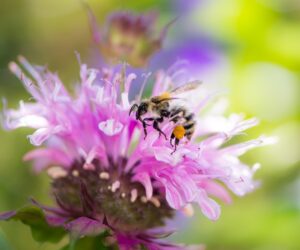
Do not judge the value of habitat restoration by its size (the old “it’s just a drop in the bucket” fallacy); any planting married to its habitat will thrive and provide sustenance and shelter for all kinds of insects and wildlife. Even the smallest intentional acts have value. We live in a green garden and share this earth with billions of others, others of every kind, circumstance, and temperament. There is enough for everyone, enough for everything, if we are mindful and tend the garden.
A habitat is many things. It provides shelter, food, and safety - it is our home, familiar territory. We depend upon its stability and familiarity. Creating a habitat for honeybees may actually be more about creating a habitat for ourselves, a place of safety and comfort where we can hold close those people and things we need and love.
(Dedicated to Jane Goodall; R.I.P.)