by Regina Rhoa
Honey bees are remarkable creatures. These insects experience a full metamorphosis, starting as eggs, then becoming larvae, turning into pupae, and finally emerging as adults. However, not all bee species follow this complete transformation. Butterflies often come to mind when thinking about insects that undergo metamorphosis, as their beauty and gentle nature make them memorable for many people, especially those who remember chasing them joyfully as children.
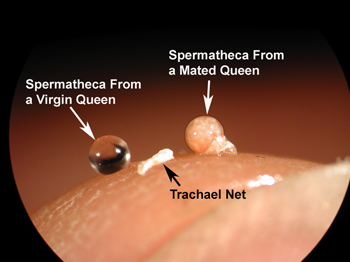
At the height of the season, a honey bee queen can lay as many as 2,000 eggs a day, which is quite impressive. Her spermatheca, a storage organ for the sperm collected during her mating flights, measures only about 1 mm across but can hold millions of sperm cells needed throughout her lifetime (see Figure 1).
The development of eggs begins at the top of her ovaries in one of over 100 ovarioles, which resemble a string of connected sausages. The egg starts as a germ cell that travels down an ovariole.
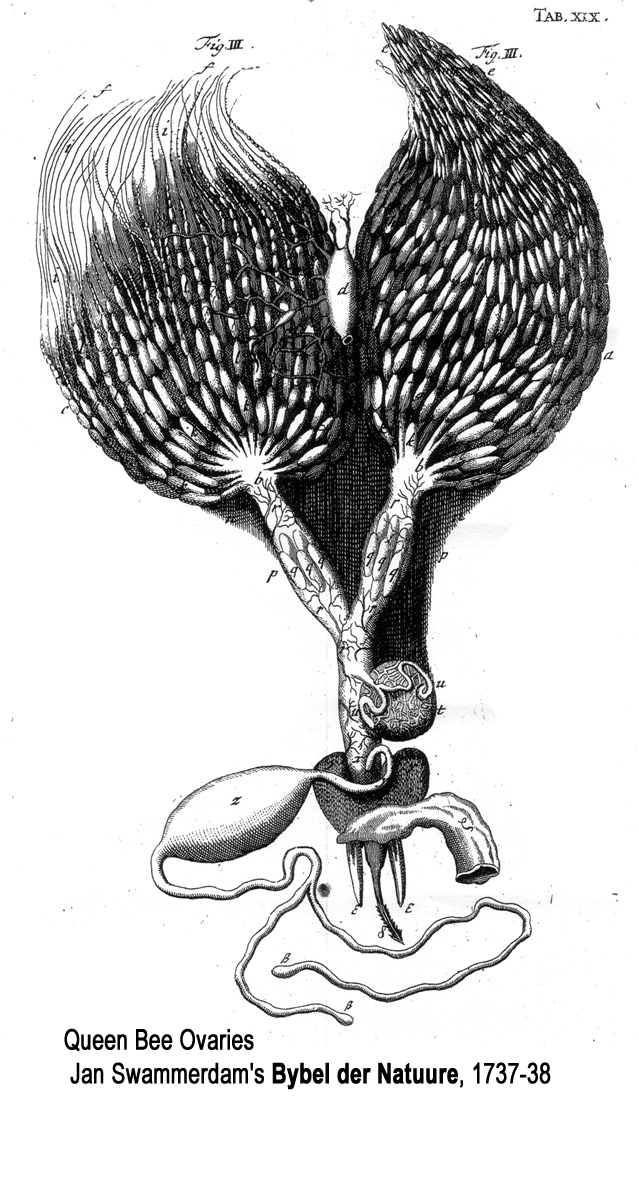
As it passes each link of the ovariole, they grow in size absorbing nutrients provided by the nurse cells. By the time it reaches the lateral oviducts, they have matured into fully formed eggs (see Figure 2). All 100 ovarioles function simultaneously, ensuring a continuous production of eggs.
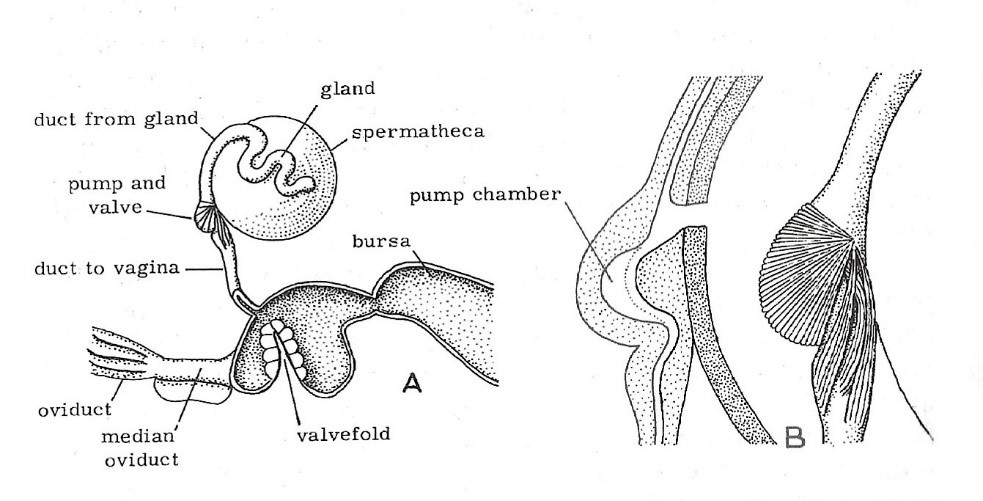
The queen determines whether to fertilize each egg by measuring the cell size with her forelegs. For eggs destined to become drones, she refrains from releasing sperm from the spermatheca. Conversely, when producing workers or queens, she opens the valvefold as the egg exists the medium oviduct and releases a measured amount of sperm—typically equivalent to one or two sperm—as the egg passes the spermatheca (Figure 3).
As the egg exits the queen, she marks the egg with a pheromone from the Dufour gland located near the sting chamber. This allows the workers to distinguish between queen versus worker laid eggs. Most people believe that workers only lay eggs if the colony becomes hopelessly queenless, but there are always a few rogue laying workers in the colony even when a queen is present. The nurse bees take care of these worker-laid eggs by cannibalizing them.
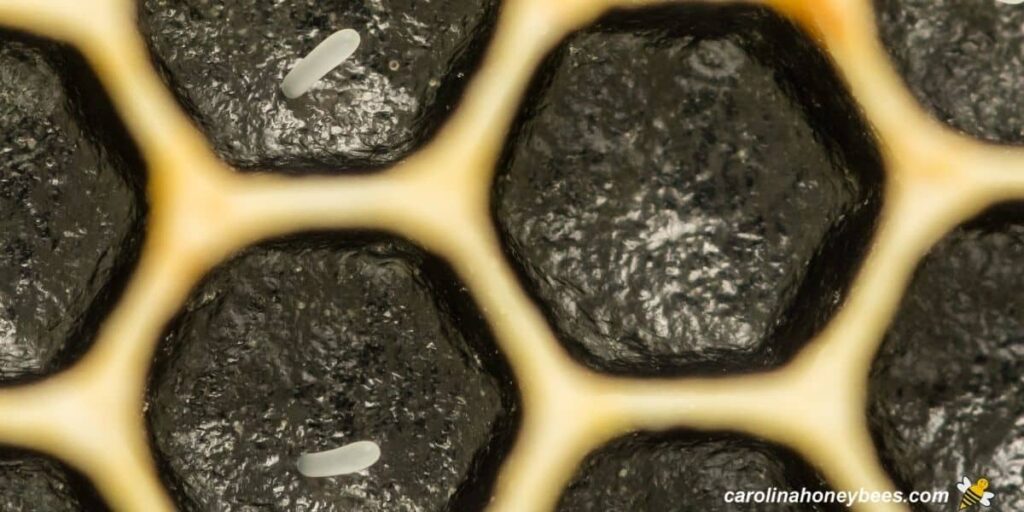
The queen will lay an egg by backing up to an empty, cleaned cell and insert her abdomen into the cell. The egg is deposited on the bottom of the cell and stands straight up on end. This egg acrobatics is accomplished by an adhesive-like substance on the surface of the egg that allows the egg tip to adhere to the cell (Figure 4). The egg stage last for 3 days whether the egg is destined to be a worker, queen or drone. Over the 3 days, the egg slowly tips over before it ecloses, where the outer membrane of the egg wall dissolves to form a larva. During the egg stage, no feeding is done by the nurse bees. Feeding doesn’t begin until the larval stage.
When the egg ecloses, nurse bees immediately begin caring for the larva, feeding it generous amounts of royal jelly. Royal jelly is made from secretions produced by the nurse bees’ hypopharyngeal and mandibular glands: the hypopharyngeal secretion is clear and rich in protein, while the mandibular secretion is cloudy and full of lipids.
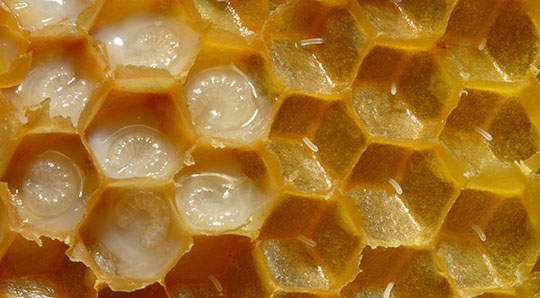
Every newly hatched larva receives an abundance of royal jelly during its first three days, often enough for the larva to be immersed in it. Nurse bees must eat a lot of pollen or bee bread to stimulate their food glands. During this stage, larvae are not fed directly mouth-to-mouth; instead, their cells are filled with royal jelly so the young larva "swim" in it (Figure 5).
If a larva is chosen early on to become a queen, it receives even more royal jelly—more than it can consume. Queen-destined larvae continue to get royal jelly throughout their development, whereas those destined to become workers or drones are switched to a leaner diet after the first three days. Following the third day, workers and drones are provided brood food that contains reduced mandibular secretion. Towards the end of larval development, nurse bees supplement the brood food with pollen and honey. As larvae grow larger, they are fed mouth-to-mouth and actively beg for food, with nurse bees constantly checking on them to see if they need more nourishment.
The larva undergoes five growth stages known as instars, during which they shed their outer layer and expand in size (Figure 6). Utilizing this photograph as a reference, individuals can learn to estimate the age of the larva (give or take a day). This is a great tool to use when determining how old your queen cell is. Worker larvae approximate growth rate is 900%, queens are 1700%, and drones by an impressive 2300%. This remarkable growth demands a substantial amount of food. The significant amount of food that drones require dictates that the bees only rear drones when resources are abundant.
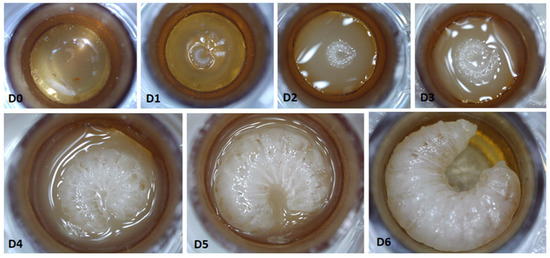
The larval stage lasts approximately 5.5 days for queens, 6 days for workers, and 7 days for drones. When the larva reaches the fifth instar, the bees cap the cell that contains a mixture of pupal casings and beeswax. If you have ever noticed, brood cells on newer drawn comb are lighter in color since it doesn’t contain the pupal casings.
Upon capping, the larva continues to feed on any remaining food and then go into its final larval molt into a prepupae. The larva stretches out with its head facing the cell capping, defecates in the cell and spins a cocoon. This occurs approximately 2 days after capping. The honey bees have silk glands in the larval stage, which eventually become the salivary thoracic gland in the adult.
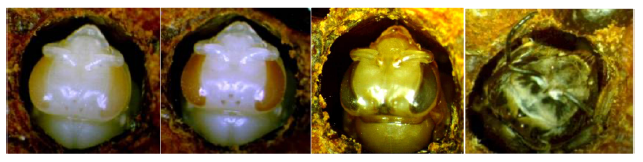
Once the cocoon is completed, the pupal stage takes about 7.5 days for queens, 12 days for workers, and 14 days for drones. During this period, the pupa completely transforms from its larval form as its body cells reorganize into the distinct features of an adult honey bee. In the final days, the outer cuticle—along with the eyes—darkens through a process called melanization (see Figure 7).
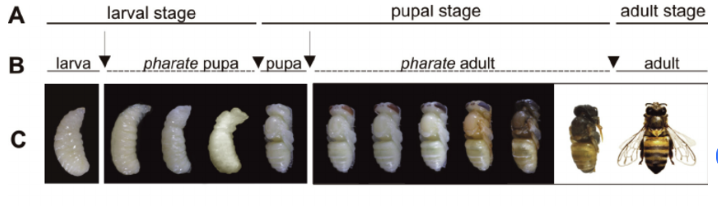
If you use your hive tool or a sharp object, you can carefully remove the capping of the cell and determine the age of the pupa by the darkening of their compound eyes (Figure 8). The honey bees will recap the cell, and it will not disturb the development of the honey bee.
After their final molt, honey bees exit their cells by chewing through the cell capping, sometimes with help from their sisters (Figure 9). If you observe closely, you'll spot newly emerged bees by their matted plumose hair, which only stays that way for a day or two as their hairs dry and their exoskeleton hardens. Upon emergence, these bees immediately start working by cleaning out their own cells and preparing them for the next generation. No rest for the weary.