
by Regina Rhoa
American Foulbrood, and other disease conditions affecting honey bees and their colonies, are often the least popular and least well understood topics for beekeepers. Nonetheless, the partnership which is beekeeping will eventually call on us all to recognize and respond appropriately and supportively to bee health challenges!
Beekeeping can be pursued for various reasons, such as environmental conservation, personal interest, honey production, or fascination with honey bees. However, the initiation of this hobby can sometimes encounter challenges. Individuals may begin their beekeeping journey by seeking guidance from online resources like YouTube or acquiring books such as “Beekeeping for Dummies.” Alternatively, enrolling in classes offered by local bee clubs can provide comprehensive education. These classes typically span a range of durations, from a single day to several weekends or even the entire beekeeping season. Despite the extensive nature of these classes, disease identification remains a relatively minor component, if covered at all. Beekeepers must continue to educate themselves with reputable sources like University website or beekeeping magazines/journals/books.
New beekeepers concentrate their inspections on drawn comb, queen identification, larva/pupa detection, and honey production. While these aspects are crucial, beekeepers must cultivate the ability to identify deviations from the norm. When a beekeeper encounters colony development challenges, they lack the expertise to ascertain the underlying causes. In such instances, they may resort to online resources like Google, Facebook groups, seek guidance from their mentor, or consult with their apiary inspector.
It is imperative for beekeepers to remain informed and proficient in identifying brood diseases. While numerous diseases exist, this article will exclusively focus on American Foulbrood (AFB). Additional diseases will be discussed in future articles.
In 1907, AFB was first discovered in the United States, causing significant colony losses. To combat this disease, progressive regulations were implemented to prevent, identify, and eradicate this disease. Most state bee laws were enacted to grant apiary inspectors the authority to quarantine colonies and notify other beekeepers in the vicinity. Pennsylvania Bee Law mandates that apiary inspectors inspect all colonies within a 2.5-mile radius of an infected colony upon the identification of AFB, thus it is critical to be registered with the PA State Department of Agriculture.
AFB is caused by the microorganism Paenibacillus larvae. This spore-forming organism can persist in woodenware for decades, with some reports of up to 50 years. It is resistant to freezing and high temperatures. Once a colony is infected with AFB, the disease is fatal. When spores encounter moisture, as experienced in a beehive, they activate and cause the infectious vegetative form of the disease. Therefore, it is not recommended to purchase used woodenware unless you are aware of the equipment’s history and the beekeeper’s practices including their state inspection history.
After feeding contaminated food by the nurse bees, the young larvae ingest spores of AFB. The larvae must be less than 48 hours old to be suspectable to the bacterium. Once in the midgut of the larvae, the spores germinate into the vegetative form of the disease and proliferate quickly. Once the nutrient levels in the larval gut are exhausted by the growth of the bacterium, the bacterium stop dividing and spores start to form. Shortly after capping, the larva breaks down and eventually dries forming a scale on the bottom of the cell (side closest to the end bar.) (Fig. 1). These scales adhere to the cell and are unremovable if you attempt to remove them. It is said that the scales can be seen if viewed with a black light in a dark enclosure.
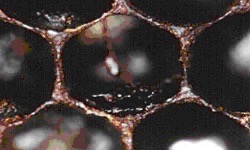
AFB Symptoms
Upon inspecting a colony, several indicators of disease progression become apparent. Notably, the colony may emit a foul odor, as suggested by the disease’s name. However, if the disease is still in its early stages, the odor may not be readily noticeable.
Other key signs to observe include pinholes in the cappings, a patchy brood pattern, and greasy, sunken cappings (Fig. 2). While the first two signs may be observed in other diseases, the greasy sunken cappings serves as a distinctive indicator. In certain instances, a larval tongue may also be present, serving as another unique sign of this disease (Fig. 3).
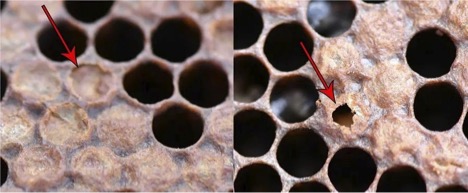
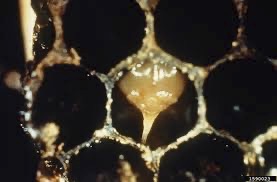
AFB Diagnosis
Although a positive diagnosis can be confirmed through laboratory testing, there are several tests that the beekeeper can perform which can rule out other diseases and are very reliable at diagnosing AFB in the field. After confirming the symptoms outlined above, uncap a sunken brood cell and use a toothpick or matchstick to gently swirl the contents within. Subsequently, slowly remove the toothpick/matchstick. The liquefied brood will adhere to the toothpick /matchstick and will ‘rope out’ approximately ½ to 2 inches (Figure 4).
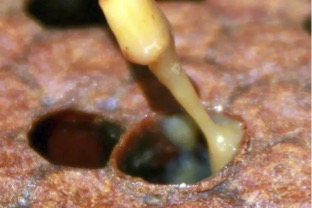
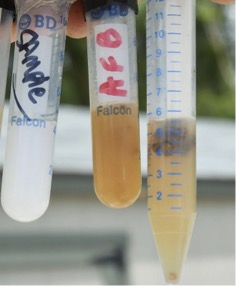
The second thing that can be done is a Holst Milk Test. Below are directions from Penn State Extension.
- Make a weak milk solution containing 1 tsp powdered milk and 100 ml water (a little less than ½ cup).
- When the powder is dissolved, divide the mixture into two small containers.
- Gather as much brown pupal mass material as possible using a toothpick, match stick, or leaf stem.
- Add the pupal mass material to one of the containers with the milk solution.
- Put both containers in a warm place, like a pocket for one hour (without adding anything to the second container).
- A positive test will result from the liquid turning clear brown. The control tube (without the pupal mass material) should show a whitish liquid (Fig 5).
If you are unable to perform the Holst Milk Test and are uncertain about roping, but still suspect AFB, you should promptly contact the apiary inspector. If your apiary inspector is unable to visit immediately, which they should, you can contact one of the senior members of your beekeeping group. This matter should not be taken lightly. AFB is a serious and fatal bee disease that can rapidly spread not only within your apiary but also to neighboring apiaries.
Quarantining Hives
If these tests are positive, you should do the following:
- Secure your colony’s entrance to prevent bees from escaping or robber bees from entering. This action will ultimately result in the colony’s demise, but it is crucial to prevent the disease from spreading to other colonies. Promptly contact your local apiary inspector. They will prioritize your request and visit your apiary for an inspection.
- If you prefer to preserve your colony, Pennsylvania beekeepers have an alternative method known as a “shook swarm.” Place a new hive body with fresh frames of foundation adjacent to your existing hive. Locate your queen and put her aside. Shake all the bees, frame by frame, into the new hive body. Exercise caution to avoid touching the frames, tools, or gloves to the new hive body. Once all the bees have been transferred, insert the queen. Provide 1:1 sugar syrup as a food source to your new colony. Subsequently, remove the original hive body and frames, placing them in a securely sealed, heavy-duty trash bag. Since the bee’s stomach are empty, they will consume the new sugar syrup to build new comb which will be free of AFB spores.
- Do not harvest or save honey, as AFB can be transmitted to other colonies. While AFB does not affect humans, it can contaminate your extracting equipment and continue the cycle of transmission to other colonies.
Handling AFB Contaminated Equipment
In Pennsylvania, there are three options available for handling of AFB-contaminated woodenware:
- Pit Burning: Dig a pit and burn all woodenware that came into contact with AFB, to include, but not limited to: hive bodies, top/inner covers, bottom boards, and frames. It is advisable to consult with your municipality regarding open burning regulations. Once all equipment is burned, cover the entire pit with soil to prevent any other bees from investigating and robbing.
- Hive Body Preservation: Hive bodies can be salvaged but the interior surface must be fully scorched using a blow torch or propane torch.
- Gamma Radiation Irradiation: Check with your local beekeeping club to determine if they have a program available at an authorized facility that utilizes gamma radiation for disinfection.
All beekeeping tools and apparel should be sanitized, if feasible. While clothing sanitation is questionable, the smoker’s bellow can be replaced, and the exterior of the smoker can be scorched using a propane torch. Beekeeping gloves should be bagged and disposed of.
Summary
Although AFB has not been positively identified within Pennsylvania for five or more years, beekeepers must remain vigilant for any potential brood diseases. Learn to identify honey bee diseases and know the course of action that must be taken for all diseases.