
December 2025
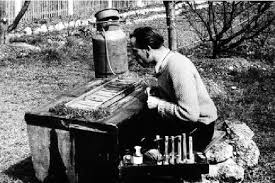
The most observed honey bee in history is likely #107, a worker that emerged from her cell in an observation hive on July 5th, 1949. She was watched constantly, her movements and activities monitored eight hours a day until finally, on July 30th, she failed to return from a foraging flight. #107 belonged to a research study lead by Martin Lindauer who sought to understand how a colony is capable of managing a multitude of tasks simultaneously and how individual bees are able to discern their colony’s needs.
A German behavioral scientist who studied under Karl von Frisch, Lindauer doubted the generally accepted notion that a worker’s labor was strictly age-dependent, but rather sensed that a colony’s labor force needed to be flexible to complete all of its tasks efficiently; a colony needed to keep the supply and demand of labor in balance. His observations (nearly 200 hours for #107 alone) revealed that, although workers generally adhere to a “work schedule,” they will readily switch tasks when needed to fill any vacancies in the demands of the colony. Lindauer also observed that each worker spends about a third of her time patrolling the hive, gathering information about her colony’s ever-changing needs. Equally important, each bee spends another third of her life just standing still, but nevertheless working - generating heat, synthesizing wax, secreting larval food, and also resting. Even when workers appear to be sleeping, they are important to the colony in that they ensure a large workforce-in-waiting, ready to act when and wherever needed.
Throughout history, observation has been the primary pathway to learning about the behavior and biology of honeybees. From Aristotle noticing a forager’s floral fidelity (approx. 344 B.C.) to Huber’s glass observation hive (blind, Huber relied on his manservant’s observational reports), from Swammerdam’s full anatomical drawings of a queen, worker and drone (1673), to de Reaumur’s description of the collection and use of propolis (1739), observation and description have advanced scientific knowledge and guided the beekeeper’s craft. Though Langstroth was not the first to notice the significance of bee space, it was he who incorporated it in the design of his moveable frame hive, stacked boxes with combs set 3/8” apart from one another and the side walls. Langstroth’s hive was easy to use, its construction relatively economical, and with the publication of his book, “Langstroth on the Honey-Bee” (1853), its use spread rapidly. Along with the introduction of comb foundation, the centrifugal honey extractor, and an effective smoker, its popularity ushered in a era when science and beekeeping became closely aligned and reciprocal, and heralded in the birth of the commercial beekeeping industry.
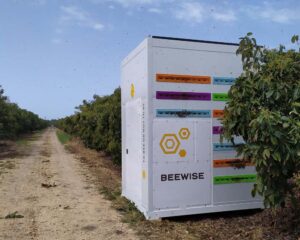
Today, the world of beekeeping is once again going through a time of epic innovation and change driven by the rapid expansion of api-centric technology which can enhance and expand our powers of observation beyond anything we have known or experienced before. The old technology seems antiquated compared to the rising sophistication of modern tools - software platforms linked to smartphones, in-hive sensors that monitor temperature, humidity, and weight, that can analyze sound and vibrations, AI-powered diagnostic tools for pest and disease detection, even complete hive automation and robotics. Indeed, the sheer volume of new information and commerce available to beekeepers is staggering, beyond anything we could have imagined; just compare today’s beekeeping journals with those from 50, even 20 years ago - the range of topics, the scope of articles, the mass of advertising - the transformation is incredible.
Change is inevitable; how one responds to change is a choice. How we think about our beekeeping makes a difference - when a colony is conceived as a complex machine that needs fixing with specific tools and interventions rather than as a wholistic living organism requiring comprehensive care, when technology’s assessment overrides the beekeeper’s nuanced judgement and contextual awareness, something valuable is lost or at least missing. Observations of honeybee behavior are still, as always, informed by one’s experience and surrounding context, observations that are augmented and elevated by the subtle cues arising from human curiosity and intuition. With our eyes we see, with our full attention we observe.