
by John Mahaffie
These are my thoughts and reflections on NAHBE from my blog at https://johnmahaffie.com/nahbe-2026-reflections/. Others who attended may have differing reflections and I’d love to hear those.
Several dozen Marylanders (and a dozen or more Montgomery County members–my "home" club) went this year to NAHBE in Louisville, Kentucky January 8-10. It was my third year attending.
The Expo was bigger than ever with about 4000 people and a huge vendor area, bigger this year than the prior two years.
For me, the best part of the Expo was talking to beekeepers and vendors about beekeeping; sharing experiences, tips, views, and agreeing and disagreeing on things. But I also heard excellent talks and came away with new insights.
The biggest thing I brought home, beyond a box of new gadgets, was new enthusiasm and energy for the coming season. I got my batteries recharged.
NAHBE is orchestrated by Kamon Reynolds, who formerly created and led Hive Life, an annual expo in Tennessee.


It’s a nine or so hour drive from Montgomery County to Louisville, KY. Driving may be essential if you expect to, or fear, you will buy a lot of stuff. But also, some of those who went with a truck or trailer generously shared cargo space and passenger space for the ride.
Also for the third year, a group of Maryland beeks (as well as some DC and their Kansas EAS Master Beekeeper study friends) hosted a potluck get together at their AirBnB, to which all were welcome and probably most of them came!
Marylanders and DCers did well in the honey show. Honey from our area was 3rd (Allan Storm) and 7th (Emily Locke) place out of 200 in the black jar contest.
About the Expo
NAHBE includes a trade show, conference sessions, and workshops. The slate of workshops on offer was much expanded this year and all were sold out. The presentations are generally from significant speaker/experts, including, this year, Randy Oliver on his research and our own Frank Linton on observation hives.

The old continues alongside the new at NAHBE: this is a hallmark of today’s beekeeping, which of course uses gear much like what was used 150 years ago. Big vendors broker a ton of hive bodies, frames, treatments and other standard equipment often at low prices (you also avoid shipping costs if you buy there).
You can readily find a speaker at the conference part who will talk against a product or practice and then see that same item for sale in the vendor show. For example, Randy Oliver discussed his testing of robbing screens, showed the problems with certain designs, with pictures of them. Those problem screens were for sale in the Expo.
Similarly, one or several portable observation hives were on offer which holds frames back to back. Frank Linton in his talk on observation hives pointed out that with that arrangement, the bees are likely to be between the frames, and you cannot see what they are doing.
But this reality is good to see; it means the organizers are allowing presenters to give their views without concern that a vendor will get upset.
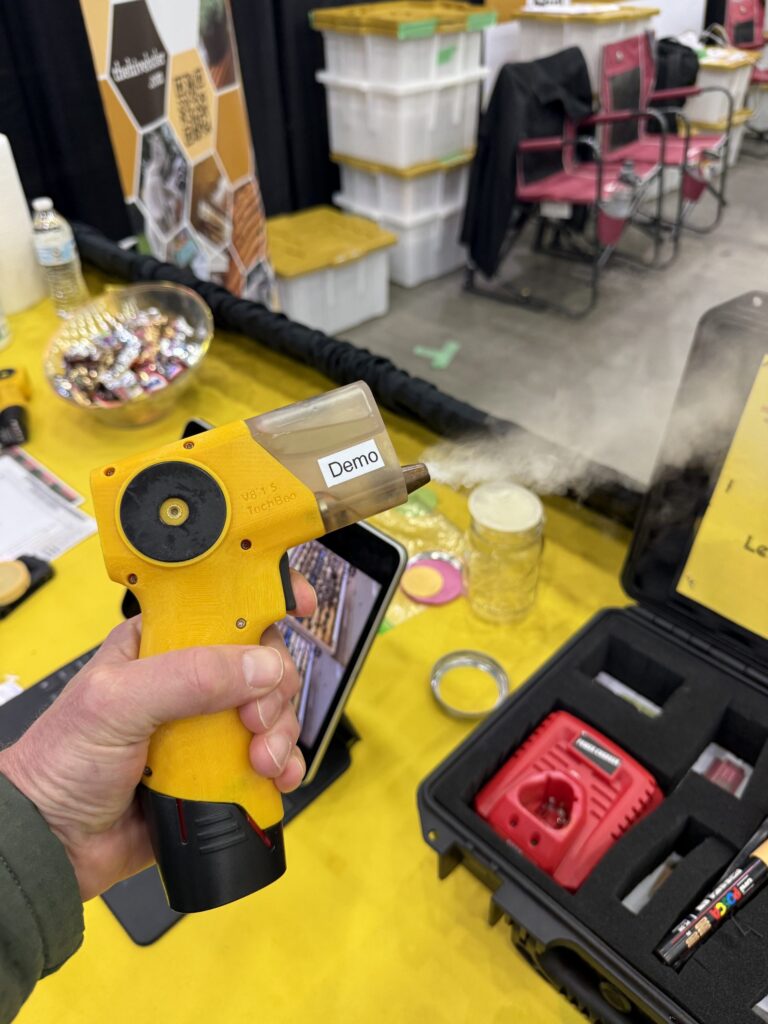
Standout topics and key observations:
- A promising smoker alternative that is a pistol-gripped, battery-charged “gun” which uses a liquid which it emits as a vapor on the pull of a trigger. This is still in beta.
- I observed even more gizmos, particular doohickies of plastic, for various purposes. I think 3D printing, at least for prototyping, and cheap injection molding production with plastics, leads to excess.
- An Australian? group is selling a mini, table-top extractor, which uses plastic cartridges of plastic comb, 8 of them in a deep frame. This is a gimmick, though a fun one. I noted it was a party trick and the guy didn’t argue. One run of the device loaded with two sides of the snap-together cartridge would yield about 6 oz.
- The insulate versus not insulate, and ventilate versus not ventilate debate (to put these simplistically) continues.
- Norroa is now for sale exclusively, for now, from Mann Lake.
- There are, to me, wholly unnecessary devices such as a bucket full alarm, which sits on the lip of a pail and alerts when the honey is close to the top.
- Fighting varroa is still a dominant subject though the rising threat of tropilaelaps takes that on as a sort of “if you think that’s bad, what ’til we have tropilaelaps!”
- There are more than ever, and probably too may, oxalic acid vaporization devices on offer.
Who comes
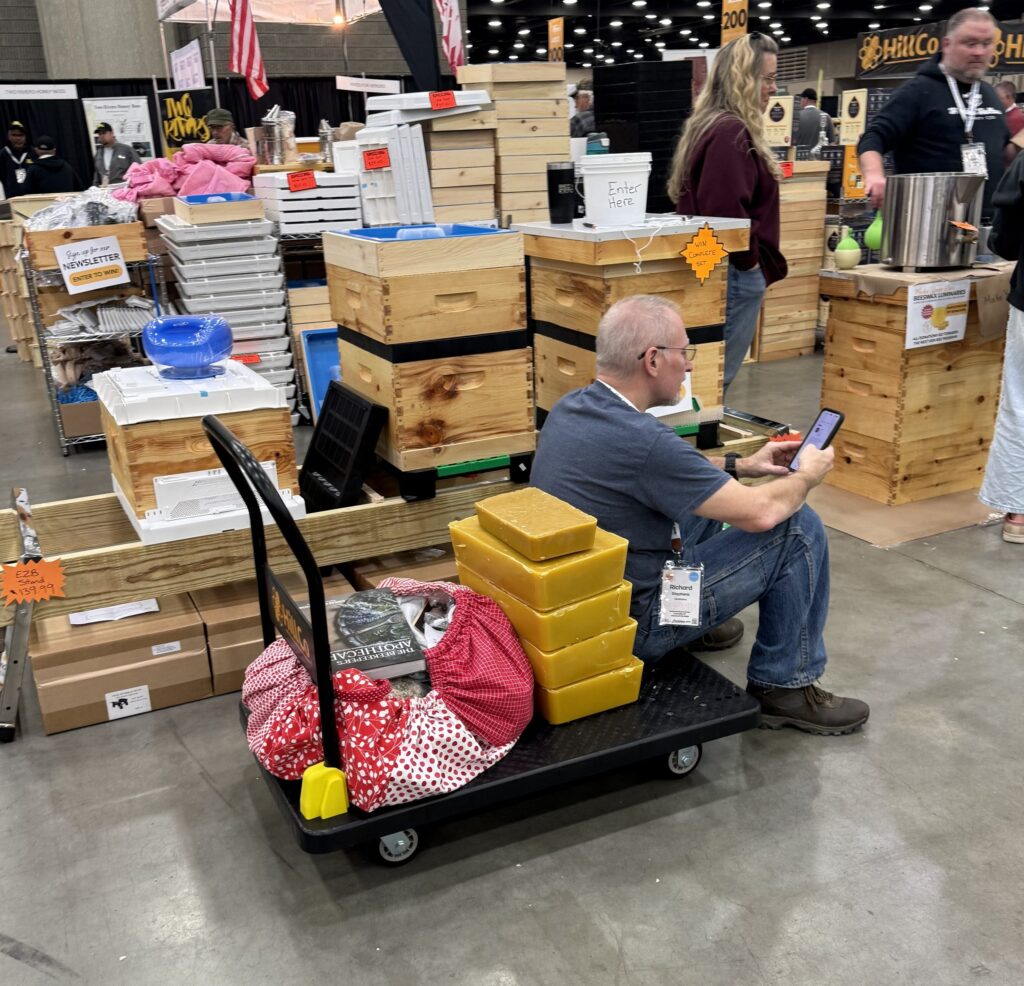
My sense is that there are lots of folks, maybe each year here has been this way, who are ramping up from a few colonies to a few dozen, maybe more. Some are farmers, some wanting a significant side-line operation to add to their family income, and some are hobbyists gone nuts.
Attendees are of different sorts:
- Sideliners growing their operations and gearing up.
- Tinkerers and experimenters and tech geeks wanting to try new stuff
- Bewildered beginners and enthralled beginners
- People there for the conversations; to be with their tribe
- Farmers and farm families for whom a bee and honey sideline is essential to their family economics
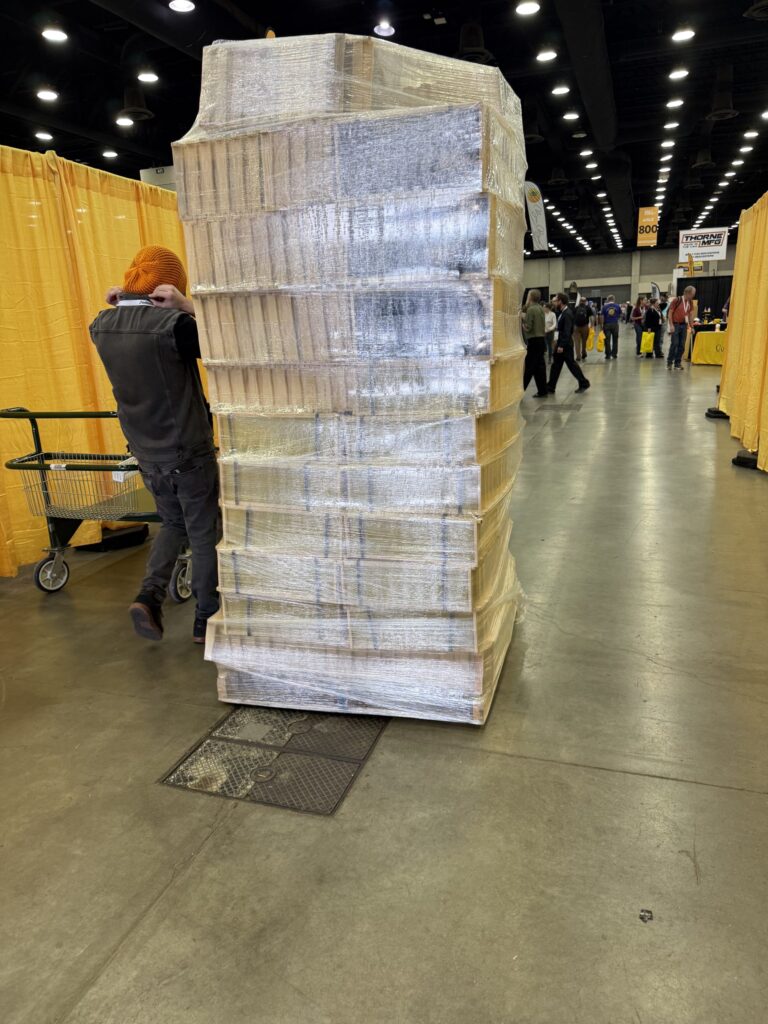
And surely more!
NAHBE would be especially good, economically, if you were building up an operation when a year or two in; you’d know enough what you wanted and needed, and wouldn’t have already bought all of it. The deals for standard gear are probably the best.
Other topics in the mix
- Queen rearing and management has a pretty strong presence and with it conversations about it being better to raise your own queens than to buy them from far away.
- AI has growing attention, including via meet ups organized during the Expo. Fred Nichols, from our club, is a leading thinking and experimenter on this.
- More polystyrene and possibly other materials for insulated hives.
- New types of internal, external, and top feeders
- Bee suits with bold claims
- and so on
I had a marvelous time for the third year in a row. In other words, highly recommended.
[Return to the February 2026 Beeline Newsletter]
