
by Zac Lamas
First, a big shout out to all who have supported the Bee Lab at UMBC.
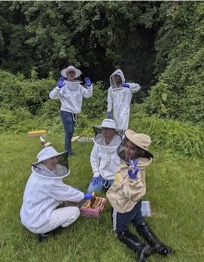
We had an incredible summer, and now that it is early October I am taking a quick breather, as our world and our bees slow down a little to reach out, say hi, to say thank you.
As a child I always wanted to become a scientist. Then late into my adult life I got to become the scientist I always dreamed of. I love it. I love pursuing unknowns and making discoveries. Much of the time I feel like a kid again, even though I am working.
Your support has helped make this experience possible for the next round of curious researchers. This year has been a testament to that. I had students who did not know anything about bees, and now they are making their own queens, making colonies, and carrying out molecular work. All students have their own projects. It took a lot of training, and work to get here. Each student wrote up a short summary for this year’s Newsletter. Please enjoy them below. And if you get a chance, say hi to my students at a bee meeting or conference.
One particular note on thi: Not all of my students will stay in honey bee research. I am ok with this. Some will, others will become medical doctors, engineers, etc. Others will move onto policy work or business. A few will stay with bees. I hear all the time from beekeepers, “What will we get out of this.” I am happy that my students are using bees as a launching pad for their careers. What I know will happen is each will become an ambassador for beekeeping for the rest of their life because of their experience in my lab. I want future surgeons, non-profit directors and policy makers that came through my lab to say, “Beekeepers? Those are my people. Pollinator habitat? That is my issue too!”. My lab pursues important findings for beekeepers and in the process we develop ambassadors for agriculture and the natural world.
- Zac
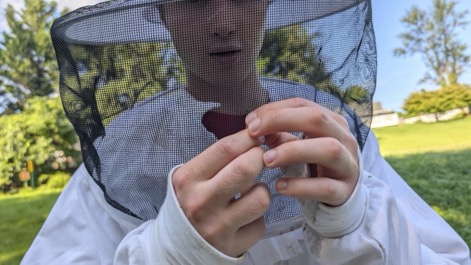
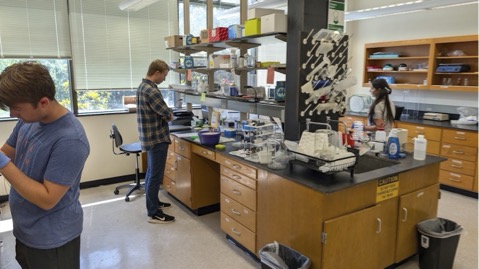
Grace Wagner
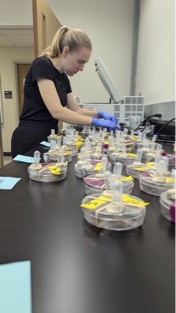
This past spring and summer I worked in the Lamas lab. For my personal project, I worked on an experiment to investigate if pesticides spreads from bee-to-bee through trophallaxis.
Bees are incredibly social creatures and are assigned different roles and responsibilities within the hive based on their chronological age. After chewing their way out of their cells, young bees serve as nurse bees, feeding the queen and larvae and cleaning the hive. As they age, they transition to making honeycomb, guarding the hive, and regulating the hive’s temperature. The eldest bees are foragers, a risky job that requires them to leave the comfort of their hive to gather nectar and pollen. I wondered if pesticide exposures could be modeled in the same way as oral viral transmission. To study this, I chose to use the world’s most used insecticide, the neonicotinoid imidacloprid. I designed cages using petri dishes with a metal wire divider in the center, air holes for ventilation in the lids, and a hole in the lid for a feeder on each side of the divider.
My experiment included 50 cages with five experimental groups of ten cages each. My groups included a control group and four groups of varying concentrations of imidacloprid in the feeders of the donor sides. I ran my third trial for 15 days checking twice a day for deaths and morbidities (muscle paralysis, uncontrolled shaking of limbs et cetera) on both the donor and receiver sides. My next step is to analyze my results using a data analysis software called R. Based on my observations, I was surprised to discover that donor bees exposed to higher concentrations of imidacloprid seemed to be less likely to engage in trophallaxis with recipient bees. In contrast, donor bees exposed to lower concentrations of imidacloprid engaged in higher levels of trophallaxis with recipient bees and expressed much lower levels of morbidities and fewer mortalities in the donor compartment while more recipient bees died off compared to cages with the higher concentrations. This work could have a large impact on agriculture as many farms use lower concentrations of insecticides in hopes of minimizing bee death, but it could be harmful to recipients bees when it enters a colony.
Of course, more research is necessary to further investigate this topic but I’m incredibly grateful for this experience and I’m looking forward to continuing my research and to present at more beekeeping conferences in the upcoming year. My project was generously supported by Project Apis m.
Thomas Bower
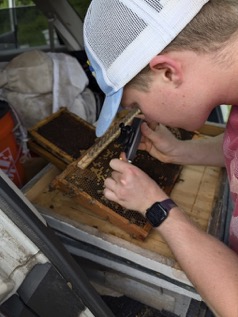
This summer, I worked as the undergraduate team leader for a season-long field trial. The aim of this experiment was to determine the effectiveness of a miticide used to prevent Varroa parasitizing virgin queens. During this experiment, my job was to organize the project, coordinate amongst the other members of the lab, and conduct the majority of the field and lab work for the project. In May of 2026, we made 80 colonies. Afterwards, we treated half the colonies and the other half we left as controls. From there we measured mite counts, viral counts, and if the virgin queens were or weren’t infested with Varroa. We repeated this process every month, and compared the two groups throughout the months of May through September. Prior to this summer, my exposure to beekeeping was minimal, and my experience with lab techniques was next to none. Clearly, this meant there was a major learning curve. Most of this summer was on the job training with long hours of fun but difficult work. However, under the guidance of Dr. Lamas, I learned not only how to be a beekeeper but also how to be a molecular biologist. Every day was a new experience, but it was never overwhelming. Questions were welcomed and even encouraged. In the end, I learned so much it is hard to even summarize it all. What I can say for sure is that this has been an amazing experience and it has fundamentally changed my life. Currently, the field work for the experiment has just finished up, but the analysis and lab work is far from over. I am not sure where the future takes me from here. Although, what I do know for certain is that I will never forget the summer I first learned how to find, pick up, and mark a queen honey bee. Thank you to everyone that made this amazing experience a reality.
Harrison Roth
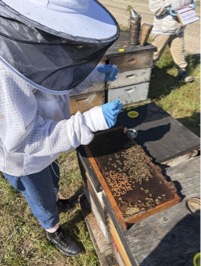
Hello, I’m an undergraduate studying biology at UMBC in Dr. Lamas’s lab.
My project is trying to answer if viruses can be spread from breeder queens to daughter queens produced through standard grafting-queen rearing methods.
What made me interested in this concept was the status quo of shipping queens across the country, and how viruses might be transferred from producers to buyers.
I have been able to learn and practice beekeeping through the lab, but I wanted to practice more. So I bought my own hives for experimentation. I have also become familiar with RNA extractions and now use qPCR to screen viruses in queens. (Right)
One of my favorite experiences through the lab was being able to see blueberry fields in New Jersey to help with the beekeeping work of another University. I'm very thankful to be a part of this lab and to have gotten to know the great people running it.
My summer project was funded by the Exeter County Beekeepers of Massachusetts.
Through this project I was able to screen the eggs of mated queens for virus, and then after grafting from them, investigate if their daughters emerged with similar viral levels.
This project is ongoing. It was a great experience to learn both field work, such as making cell builders, nucleus colonies and grafting queens, and laboratory work such as RNA extractions and qPCR.
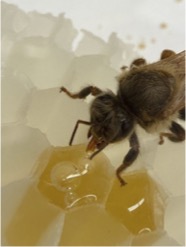
I hope to continue studying viral infections in queens for my graduate work at UMBC. (Image on the riight: A queen I produced feeding herself in the lab.)
My name is Brandon Tringa and I am a Masters Student in the Lamas Lab.
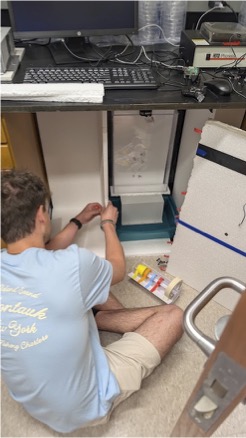
I have been working on a very interesting project which is investigating whether interactions between cold exposure and viral infections occur.
Specifically, I am interested in determining if the cooler temperatures that foragers encounter on foraging bouts can contribute to them developing a higher viral load.
In the first part of my project, I had to learn how to inject honey bees with viruses. While it took a couple hundred bees to get the hang of it, I now have a result which is very intriguing to me!
Bees which were subjected to both virus and a 20-minute bout of cold seemed to have significantly higher mortality levels!
For the second part of my experiment, I wanted to test a more realistic situation. I created a plexiglass arena and placed it within a temperature controlled styrofoam area to mimic a bout of foraging the best I could.
I also had to learn how to construct code using a RaspberryPi, something I have never done before, in order to capture the video footage I wanted.
This part of my project was a ton of fun as it allowed me to engage my creative side, and use a wide variety of skills which I have gathered over the years.
I am currently working on the molecular analysis for both parts of my project and analyzing the video I have gathered. I am very excited about the rest of the data I have yet to interpret!
My work was funded by NAPPC, and I just want to say a heartfelt thank you to both Zac and to all of those which have supported my research thus far financially. I am deeply passionate about science, but it takes others who are also deeply passionate to keep scientists like Zac and I going, so again, thank you.
Hi my name is Vrinda Thapliyal and I am screening antivirals to protect honey bee queens.My work was funded by the California State Beekeepers Association.
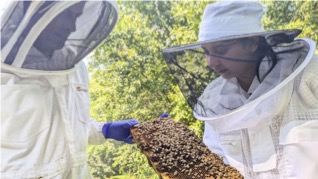
I am excited about this work, and the impacts it can have on queen producers. Right now I am trying to get more trials done before the autumn weather shuts everything down for this season.
I produce queens with Zac here at UMBC, and then I provide those queens with possible therapeutics after we inject them with viruses.
I was able to make huge strides with funding, and by looking at the incredible work of Dr. Jay Evans and applying his project to queens. I hope to turn this work into a PhD, where I want to study cellular mechanisms important in honey bee queens impacted by viruses.
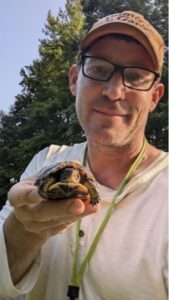
And Hi, my name is Dr. Zac Lamas. I am incredibly proud of my students, and the beekeeping community that has supported this lab.
More and more of my work involves training and guiding these students. This is such a transition for me. I normally keep to myself, and work alone. Daily I am now engaged with these bright, young students who have creative interests of their own.
I am not sure ultimately where this will lead me, will lead us. I hope, it is with lots of projects, help for beekeepers, and better bee health. For all the fun along the way, thank you for reading.
Our lab was generously funded by beekeepers, and the projects supported by beekeeping organizations.
The lab and this work would not be possible without this support. Please find acknowledgements on the last page of this year’s newsletter.
The Disease Ecology Lab at UMBC was generously supported by beekeepers
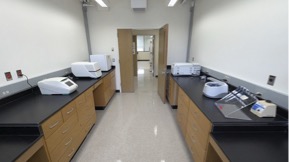
Your donations allowed me to purchase the equipment to setup our molecular lab. I truly cannot thank you enough for your support, and going out of your way to make this happen. If I missed your name, it was not intentional.
Thank you so much to: Andy Strehlow, BZ Bee Pollination, Kara Alcamo, Clyde Strang, Patty Sunberg, Shane DeHaven, Randy Oliver, Stewart Merritt, Toni Burnham, Ruth Willians, Mello Pedro, Judy Treible, Daphne Fuentevilla, Andrea Reed, Matt Beekman, Theresa Martin, Grace Mehl, Dawn Marie and Moira, Ruth Williams, Nissequogue Apiaries, Adrian Cagle, Ann Atkinson, Becky Tipton, Greg Berger, Janet Peck, KT Thompson, Richard Reed, Shelly Kulhanek, Susan Crook, Scott McArt, Joanne Kalinowski, Dennie Best, Russell Sprangel, Dr. James O’Brien and Tina O’Brien, Tina Opp, Robert House, Rein Verbeek, Robin Stafford, Janine Spendlove Garner, Elliot Hunt, Frank Roberts, Gentian Drumright, Bryan Zavada, Cathy Cameron, Brandon Antonio, Granite State Apiaries LLC, Andrea Langworthy, Sue Rowland, Jason Hough, Dr. Judy Chen and Dr. Jay Evans.
Thank you to the generous support: Maryland State Beekeepers, Carol County Beekeepers, California Queen Breeders Association, Central Maryland Beekeepers, NH Beekeepers, Indiana State Beekeepers, Wyoming Beekeepers, Long Island Beekeepers, Eastern Colorado Beekeepers, and the Colorado State Beekeeping Association, The Anderson County Beekeepers Association, Kansas Beekeepers, Kentucky State Beekeepers, Oregon State Beekeepers and the Beekeepers of Indiana, The Seacoast Beekeepers, Spartanburg Beekeepers Association, Merrimack Valley Beekeepers and the D.C. Beekeepers
Funded research was supported by: California State Beekeepers Association, Project Apis m., Exeter Beekeepers, NAPPC and Greenlight Bioscience.
Dr. Zachary Lamas
UMBC Honey Bee Research
1000 Hilltop Circle
Baltimore, MD 21250