
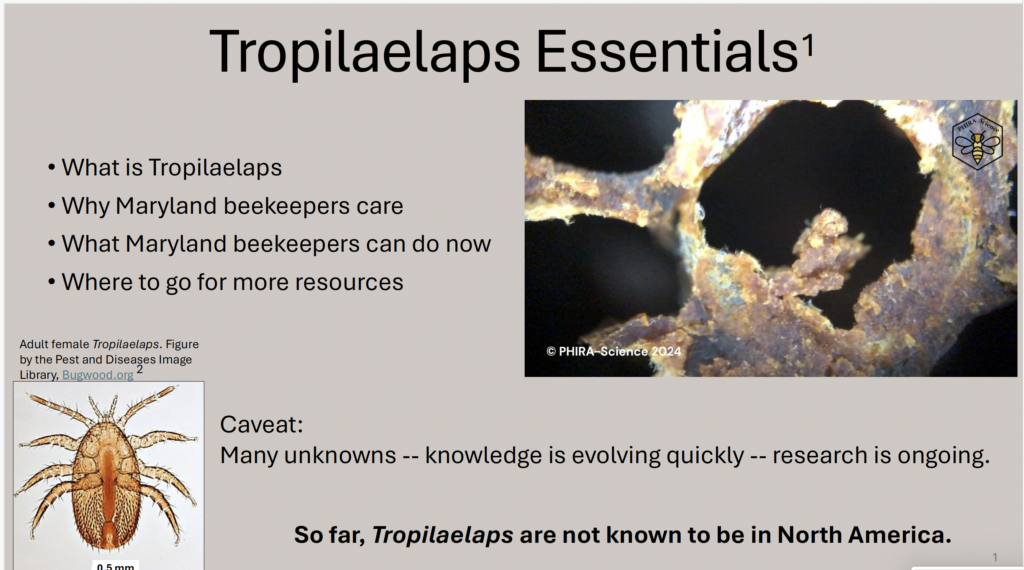
Tropilaelaps Presentation SLIDES - Marian Iannuzzi (Download)
AUDIO RECORDING of MEETING
You are not logged in. Please login to gain access - Thanks!
LOGISTICS
EVENT: MSBA Advanced Learning Event
DAY: Saturday, February 14 (YES, VALENTINES DAY!)
TIME: 8:30AM - 2-ishPM
ZOOM: IN-PERSON ONLY
LOCATION: UMBC Interdisciplinary Life Science Building
ADDRESS: 1000 Hilltop Cir, Baltimore, MD 21250 (MAP)
ROOM: TBD
LUNCH: Pizza Provided, or BYOD to hear the lunchtime speaker
AGENDA
For easier table reading, rotate your phone to landscape.
| 8:30 am | Refreshments, Coffee, Donuts, etc. | |
| 9:00 am | Opening and Welcome | David S. Schultz, MSBA President EAS Certified Master Beekeeper |
| 9:10 am | Apiary Inspector's Report | Cybil Preston, EAS Certified Master Beekeeper, MD State Chief Apiarist |
| 9:30 am | “Tropilaelaps Essentials” | Marian Iannuzzi MBK Study Group Member |
| 9:45 am | “ABF Conference Report” & Financial Report Out | Lisa Marie Ghezzi, EAS Certified Master Beekeeper |
| 10:00 am | Break | |
| 10:30 am | “University of Maryland Honey Bee Laboratory” | Eric Malcolm Apiary Manager Apiculture Extension Educator UMD Bee Lab |
| 10:55 am | “Queen Rearing Panel Discussion” | Cory Stevens, EAS Certified Master Beekeeper (Stevens Bee Co.), Dr. Robyn Underwood (Penn State), Russell Sprangel, EAS Certified Master Beekeeper |
| 12:10 pm | Lunch Provided by MSBA | Pizza Provided by MSBA, or BYO, to hear the lunchtime speaker |
| 12:30 pm | Lunch & Learn Presentation: “AI-and Honey Bee Keeping” | Fred Nichols, MBKSG Certified Journeyman Beekeeper |
| 1:15 pm | “Meet our New MSBA Officers” | Elaine Storm, MSBA Vice President |
| 1:45 pm | Closing Remarks | David S. Schultz, MSBA President EAS Certified Master Beekeeper |
| 2:00 pm | Adjourn |
PRESENTATIONS
Queen Rearing Panel
Panelists: Robyn Underwood, PhD; Corey Stevens; Russel Sprangel (See bio section)
These three experts will answer your queen rearing questions!
DISCOVER:
- How their approach to queen rearing has evolved
- What improvements will they try next
- Which queen qualities they breed for
- How they evaluate those qualities
- Whether hygienic behavior is important to their operation and/or customers
- How they receive and process feedback from customers
Submit YOUR QUESTIONS for the panel:
| Name | |
| David Schultz |
AI & Honey Bee Keeping
Artificial Intelligence (AI) is set to bring the biggest changes to beekeeping since the Langstroth hive. It is giving us "check engine lights" for our colonies, and new, bee-safe ways to kill Varroa. Beekeeper Fred Nichols will step us through the advanced tools AI is giving beekeepers right now, and a peak at even more powerful tools on the horizon.
Quick Preview of sensors already available or on the way include: landing board monitors that can tell if nectar and pollen foragers were successful, microphones that detect changing sounds in the hive to determine queen status, thermometer grids that track brood and cluster locations, and hive scales that look for weight trends (honey flow? swarm? robbing? Dearth?) But the seemingly magical goal of AI is to analyze these measurements all at once to provide real-time health assessments and predict colony health. Getting the most out of AI still faces hurdles, like getting all the equipment to talk with each other, bringing down the costs, and keeping the bees from propolizing the sensors! But all those are surmountable, and bees definitely have AI in their future.
UMD Bee Lab
Find out what the UMD Bee Lab has been up to!
Eric Malcolm will highlight the UMD Bee Lab’s recent work. Just one example:How many hours it really take to care for bees?? UMD Bee Lab kept a detailed time-log of beekeeping chores. You’ll be amazed to see how it all adds up.
UMD Bee Lab also publishes a weekly report, "Last Week in the Apiary". It is a great resource to get suggestions of chores to do, right now, and how other bees in our area are doing right now.
Get it FREE from UMD Bee Lab:
- To subscribe to "Last Week in the Apiary" and/or receive updates from UMD Bee Lab including workshop availability or other big announcements, please visit umdbeelab.com/last-week-in-the-apiary and click "Get Notifications."
- Want to keep better beekeeping records in 2026? Visit umdbeelab.com/recordkeeping for free recordkeeping resources!
WHAT IS THE UMD BEE LAB:
UMD Bee Lab serves Maryland Beekeepers. We offer diagnostic services to the public, researchers, and industry members conducting honey bee health research. We also provide extension programs and resources to educate and support our local beekeepers.
BIOs
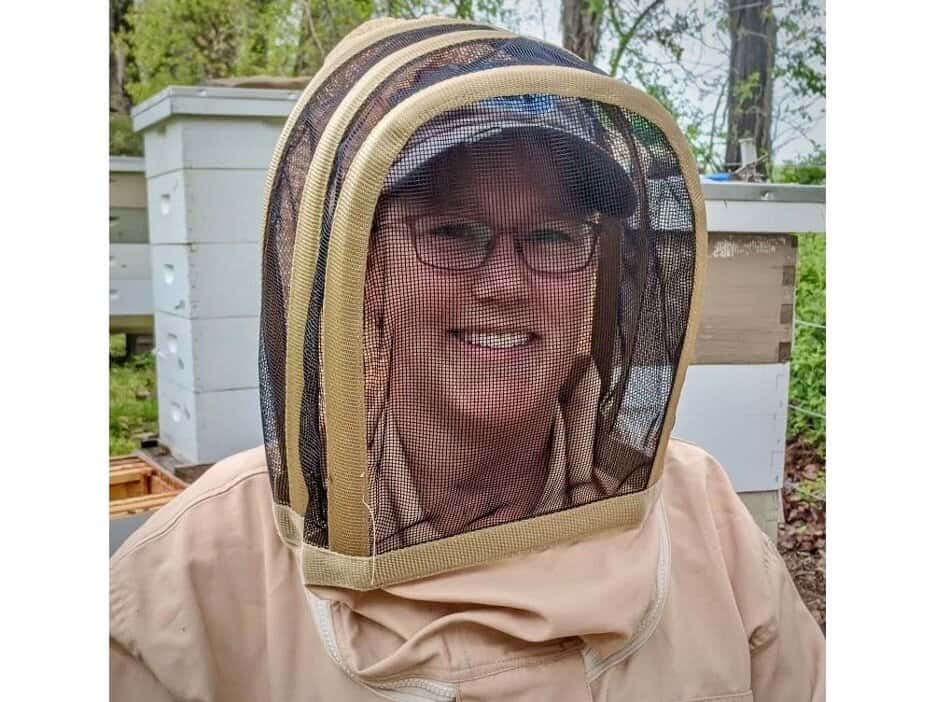
Dr. Robyn Underwood was born and raised in Pennsylvania. She studied Entomology and Applied Ecology for her bachelor's degree at the University of Delaware, Newark, DE, where she fell in love with honey bees and beekeeping. She went on to study honey bees further by researching the use of formic acid to control parasitic mites in colonies kept indoors for the winter at the University of Manitoba in Winnipeg, Manitoba, Canada, where she obtained her PhD. She returned to PA and continued conducting applied research while working as an Assistant Professor of Biology at Kutztown University, and later as an Assistant Research Professor at Penn State University, University Park, PA. Her research and extension work has allowed her to interact with the large network of beekeepers from across the commonwealth, as stakeholders, advisors, and students. Robyn is very excited to have joined Penn State Extension in 2022, where she continues to engage with the beekeepers in PA and beyond while conducting applied research.
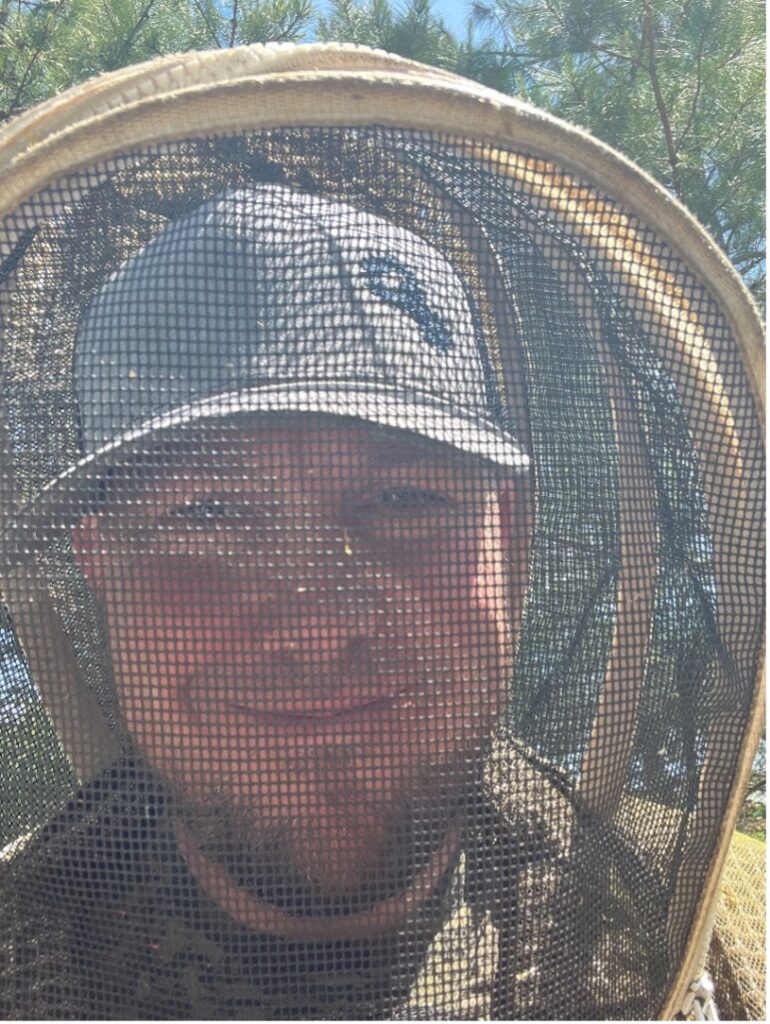
Cory Stevens comes to us from his 27 acre farm in Bloomfield, Missouri; which he
manages for wildlife and pollinator habitat. Cory and his wife Jaime own Stevens Bee
Company where they have selected a VSH line of bees they call "Missouri Mite
Hunters." Cory is a Past President of Missouri State Beekeepers Association. He was
certified as a Master Beekeeper by the Eastern Apicultural Society in 2013, and earned
a MS in entomology from University of Nebraska - Lincoln. He was trained by Sue
Cobey in 2014 to instrumentally inseminate queen bees. Cory slips bees into random
conversation with strangers, and annoys his wife by constantly talking about bees.
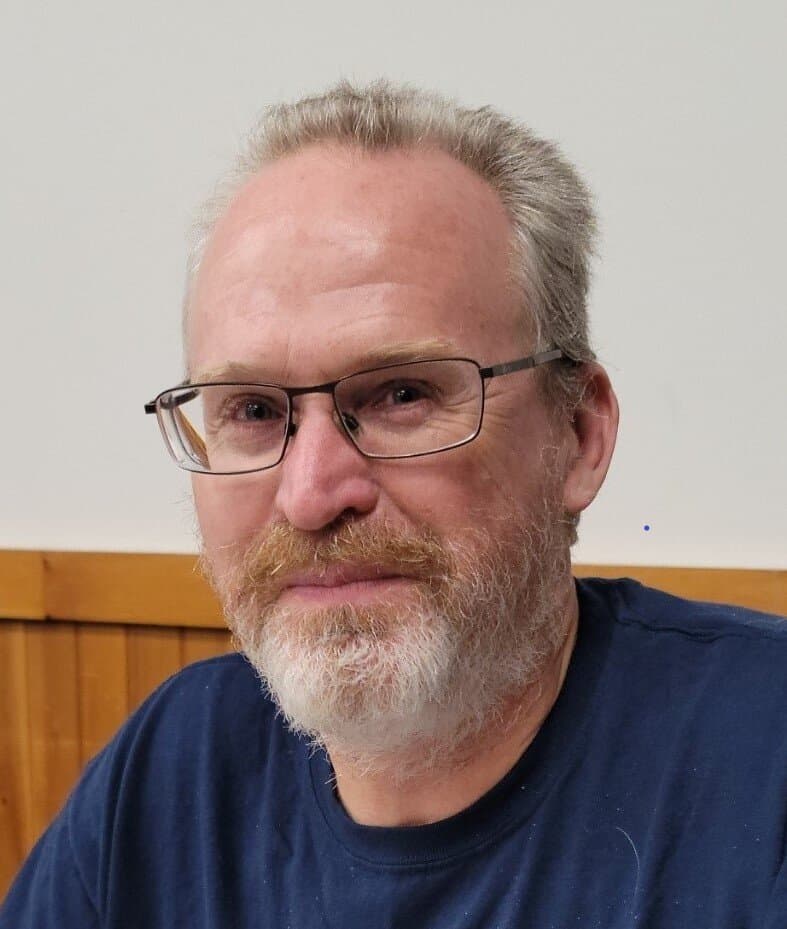
Russell Sprangel started keeping bees in 2017 with a hive setup and a new beekeeper’s course as a Christmas present, from his wife Lisa, which she totally regrets to this day. He is the past VP and President of CCBA and past Vice President of HCBA. He is an EAS Master Beekeeper, certified in Ithaca, NY in 2022. He teaches during the beekeeping calendar in the clubs training Apiary, all any aspects of beekeeping students ask for. Early in his second year of beekeeping he decided that queen rearing could not be the black magic everyone said, and you do not need 10 years of experience to do it. So, with a little book learning, and no formal instruction, he jumped in to find what the fuss was about. Turns out it is magical, but in a good way, and can be one of the most rewarding aspects of beekeeping even on the small hobby scale.

Fred Nichols is on leave from the John Hopkins Applied Physics Lab (APL) where he was a program manager in National Security and Intelligence Information Systems. Prior to APL, he was a member of the Senior Executive Service (SES) as Counselor to the Undersecretary for Preparedness at the Department of Homeland Security. His portfolio was preparedness and risk mitigation for national critical infrastructure against all Chemical, Biological, Radiological, Nuclear, Explosive (CBRNE) as well as cyber threats. Prior to government service, he was the Vice President of Government Affairs for the National Association of Manufactures. He lives with his wife on a small farm in Poolesville Maryland.
Eric Malcolm is the Apiculture Extension Educator and Apiary Manager at the University of Maryland Bee Lab. His work focuses on keeping healthy bees, outreach, education, and helping beekeepers make informed decisions using their own observations, monitoring techniques, and scientifically proven best management practices. In his off time, he runs a sideline beekeeping business called Backyard Apiaries, that provides apiary management services to clients. In years past, he co-coordinated the Bee Informed Partnership’s Sentinel Apiary Program, a national citizen science program designed to help improve monitoring practices and establish essential skills for beekeepers of all levels. He is passionate about honey bee health, beekeeping, working with beekeepers, and in his free time enjoys learning about wild edible and medicinal plants, and mushrooms, enjoying time with his family, traveling, hiking, camping, and backpacking.
VENDORS!
VISIT THESE VENDORS AT OUR MEETING:
Whistlepig Woodcraft
- Website: www.whistlepigwoodcraft.com
- WE WILL HAVE: Boxes, frames, bottom boards, inner covers, lids, 4 jar feeders
- TO PRE-ORDER for pick-up at the meeting: Call or text (443-398-0814), or email john@whistlepigwoodcraft.com
- Cash or checks accepted, 3% extra for credit cards
Three Spartans Apiary
- Website: https://three-spartans-apiary.square.site/
- WE WILL HAVE: Beeline woodenware - boxes, lids, inner covers, bottom boards, taking orders for spring nucs
- TO PRE-ORDER woodenware for pick-up at the meeting: Call/text 301-471-5738 or email threespartansapiary@gmail.com
- Cash, Zelle, Venmo, Credit Card (3.5% credit card fee)
- MSBA Valentines Discount: 5% off all Beeline woodenware/equipment from catalog/website.
Aperture Apiary
- Website: https://apertureapiary.com/
- PRE-ORDERS ONLY: Comb Keeper at https://apertureapiary.com/products/combkeeper
- I will not be at the meeting, but Valerie Wampler has kindly offered to take any pre orders to the meeting.
- MSBA Valentines Discount: 10% off with code “MSBA”, 20% off orders of 20 bags or more, and 25% off 30 bags or more. IMPORTANT: at checkout, you must select "Pick up for delivery at the MSBA meeting."
DOOR PRIZE!
A Surprize Exciting Bee Related Prize to the LUCKY WINNER!